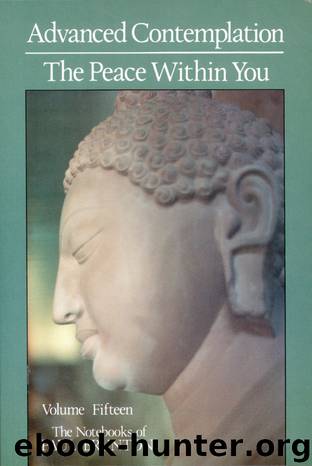
The Notebooks of Paul Brunton 15 - Advanced Contemplation, The Peace Within You by Paul Brunton
Author:Paul Brunton [Brunton, Paul]
Language: eng
Format: epub
Tags: Philosophy
ISBN: 9780943914435
Publisher: Larson Publications
Published: 2018-01-15T05:00:00+00:00
7 Contemplative Stillness
1
No picture of a beautiful landscape can ever be a substitute for the landscape itself. All ideas of the higher consciousness are at best pictures in thought, and can never be a satisfactory substitute for the consciousness itself. If he wants to pass to the reality pictured by them he will have to pass out of the second stage into contemplation, the third stage.
2
If he progresses with these ego-crushing efforts and with these ever-deepening meditations on the Divine, he will come nearer and nearer to the true core of his being.
3
The ultramystic exercises follow after and are the sequel to ripe reasoned thinking. They banish thoughts only after thoughts have done their utmost work, whereas ordinary yoga banishes thoughts prematurely.
4
At this exalted stage, mind abides immersed in itself, not in its productions and functions.
5
This condition of concentrated quietness is what the Master Lu Tze quaintly describes as "the condition in which you sit like a withered tree before a cliff."
6
When the ego contemplates the Overself with perfect attention, there is dismay in hell but joy in heaven.
7
Meditation often leads to fatigue but contemplation never. The one takes strength from him, the other gives it to him.
8
If meditation may have unfortunate results when its concentrative power is applied negatively or selfishly, contemplation – its higher phase – may have similar results when its passive condition is entered without previous purification or preparation. Miguel de Molinos knew this well and therefore put a warning in the preface of his book The Spiritual Guide which treats with the authority of an expert the subject of contemplation. "The doctrine of this book," he announced, "instructs not all sorts of persons, but those only who keep the senses and passions well mortified, who have already advanced and made progress in Prayer."
9
There is a single basic principle which runs like a thread through all these higher contemplation exercises. It is this: if we can desert the thoughts of particular things, the images of particular objects raised by the senses in the field of consciousness, and if we can do this with complete and intelligent understanding of what we are doing and why we are doing it, then such desertion will be followed by the appearance of its own accord of the element of pure undifferentiated Thought itself; the latter will be identified as our innermost self.
10
Now an extraordinary and helpful fact is that by making Mind the object of our attention, not only does the serenity which is its nature begin to well up of its own accord but its steady unchanging character itself helps spontaneously to repel all disturbing thoughts.
11
There is, in this third stage, a condition that never fails to arouse the greatest wonder when initiation into it begins. In certain ways it corresponds to, and mentally parallels, the condition of the embryo in a mother's womb. Therefore, it is called by mystics who have experienced it "the second birth." The mind is drawn so deeply into itself and becomes so engrossed in itself that the outer world vanishes utterly.
Download
This site does not store any files on its server. We only index and link to content provided by other sites. Please contact the content providers to delete copyright contents if any and email us, we'll remove relevant links or contents immediately.
Becoming Supernatural by Dr. Joe Dispenza(8223)
Crystal Healing for Women by Mariah K. Lyons(7933)
The Witchcraft of Salem Village by Shirley Jackson(7278)
Inner Engineering: A Yogi's Guide to Joy by Sadhguru(6798)
The Four Agreements by Don Miguel Ruiz(6767)
The Power of Now: A Guide to Spiritual Enlightenment by Eckhart Tolle(5788)
Secrets of Antigravity Propulsion: Tesla, UFOs, and Classified Aerospace Technology by Ph.D. Paul A. Laviolette(5373)
The Wisdom of Sundays by Oprah Winfrey(5165)
Room 212 by Kate Stewart(5129)
Pale Blue Dot by Carl Sagan(5012)
Fear by Osho(4741)
The David Icke Guide to the Global Conspiracy (and how to end it) by David Icke(4721)
Animal Frequency by Melissa Alvarez(4475)
Rising Strong by Brene Brown(4465)
How to Change Your Mind by Michael Pollan(4358)
Sigil Witchery by Laura Tempest Zakroff(4248)
Man and His Symbols by Carl Gustav Jung(4138)
The Art of Happiness by The Dalai Lama(4132)
Real Magic by Dean Radin PhD(4131)
